
Authored by Rachel Buss, VP of Strategic Insights
For decades, restaurants have been able to react to diet trends with visible signals and callouts. Menus at Applebee’s carried Weight Watchers logos. Brands tied emotions to the calorie counts, such as Chili’s Guitless Grill. “Under 500 calories” badges appeared next to entrées. These types of additions to menus were designed to make choices easy for customers watching their weight and allow them to still partake in the fun.
The intent was helpful. The effect, however, was potentially polarizing, often making patrons feel their orders said something about them, labeling and often advertising a weight journey they weren’t wanting to openly shout from the roof tops.

Another weight trend is upon us with the spread of GLP-1 medications, and restaurants once again have a choice about how they approach diners. The nature of GLP-1, however, means that many of these users aren’t tracking calories and are free from sticking to the offerings endorsed by a weight loss company. Instead, they are able to choose favorites, just in smaller portions, focusing more on protein and fiber. But like the previous weight loss trends, there’s again a perceived stigma of “cheating” on their weight loss journey. So again, consumers want to covertly order foods that meet their needs, without announcing their weight loss journey to the world. This means that for restaurants, the opportunity is not to create a “GLP-1 menu.” It is to redesign menu architecture so it works for a world of variable appetite.
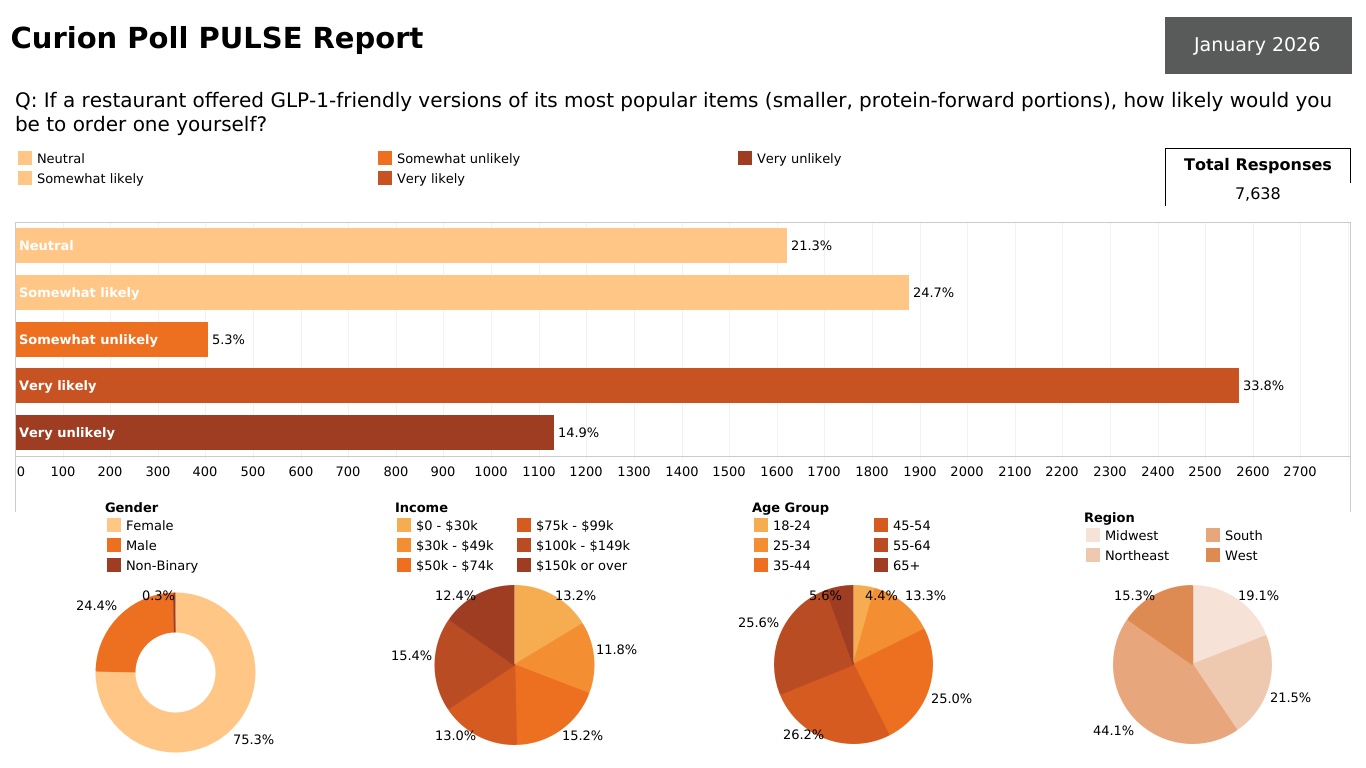
And while consumer data shows the demand is real, realizing that upside may be difficult. Curion Insights recently fielded a study with over 8,500 consumers and found that 58.5% of diners would be more likely to order smaller, protein-forward versions of popular menu items if offered. At the same time, the resistance to being labeled is strong. Though such a large percentage is interested, 37.4% say they are not interested in a menu labeled as GLP-1-friendly. Again, consumers are signaling that they are interested in the offering but rejecting the identity. This creates a potential trap for operators. If you market the section as “GLP-1 friendly,” you may repel the intended target market.
These preferences do not belong to GLP-1 users alone. They mirror the priorities of consumers who are macro focused and protein chasers, striving for the current 1 gram of protein per pound of body weight made popular by social media, whether for weight-management, medical conditions like PCOS, or general fitness fanatics.
For years now, these guests have been pushing trends in the CPG world where protein is being added to popcorn and instant mashed potatoes to help achieve goals. When choosing to eat out, these consumers are trying hacks and secret menus to achieve their goals. What GLP-1 has now done is bring those needs into sharper focus. The same menu architecture that supports a diner with reduced appetite also supports a runner refueling after a workout, a guest tracking macros, or someone simply trying to feel full without being weighed down. This overlap is what makes the opportunity mainstream rather than niche.
While slower than their CPG competitors to invest in the GLP-1 space, restaurants are starting to notice.
- Chipotle Mexican Grill launched a curated High Protein Menu with names centered around protein and fiber, with GLP-1 mentioned but only in the fine print.
- Shake Shack introduced a Good Fit menu which emphasizing protein and reduces refined carbs under the arch of “However you eat, whatever your goals, we’ve got you covered.”
- Smoothie King, one of the first restaurants to see an opportunity in this space, rolled out a GLP-1 Support Menu featuring high-protein, high-fiber smoothies designed for smaller appetites. They are one of the few brands that leads with GLP-1 front and center, in both the overarching menu name and product names, as well as one of the only to connect it to another diet such as the Keto Champ™ GLP-1 Berry.
- Olive Garden has found a way to appeal to two segments with its Lighter Portions menu, which not only achieves smaller portion sizes desired by GLP-1 consumers, but also lower prices compared to the typical full-sized entrée, attacking both the need for smaller portions but also provide offerings to more budget conscious consumers.
These moves reflect the same pattern of protein and portion sizes, with most nodding to GLP-1 but not waiving a “I’m on a diet” flag every time a customer orders. Some are also taking the opportunity to broaden the audience, whether other nutritional seekers or budget conscious consumers. Whether early adopters like Smoothie King will retain their overt labeling remains to be seen as the overall trend continues to evolve.
So, what are consumers doing when these options aren’t available? Many order full entrées and eat only a portion, taking leftovers home or leaving significant food uneaten. Others default to appetizers or sides as their main meal, share an entrée, or order from the kids’ menu. Kids’ meals are uniquely positioned in this shift. They were originally designed for smaller appetites and simpler builds, which makes them a natural workaround for adults eating less. As GLP-1 adoption continues, kids’ menus are increasingly being used as an adult portion solution. A quick search of Reddit forums like r/Ozempic and r/Semaglutide reveals GLP-1 users actively sharing their favorite kids’ meal orders at national chains. Curion’s own polling reinforces this behavior: among consumers currently using a GLP-1, 24% say they often order from the kids’ menu. For restaurants that treat kids’ meals as loss leaders, this creates a real margin risk. Ensuring appropriately priced, adult-appropriate smaller portions exist elsewhere on the menu may be critical to capturing this demand without eroding profitability.
As the CPG world knows, this shift is bigger than GLP-1. It is appetite economics and changing the way consumers eat, how much they eat, and ultimately buy at every point of sale. Even among guests surveyed who said they were unlikely to ever use GLP-1 medications, 56.9% were still interested in ordering smaller, protein-forward options.
For operators, this translates into three clear menu imperatives.
- Portion architecture: Intentionally designed smaller builds with full flavor integrity. Full, lighter, and mini versions of core items that feel like smart choices, not compromises, without the worry that a restaurant may not serve them the kid’s meal due to printed age limits.
- Protein replaces “low-calorie”: Protein is most associated with satiety and helping control hunger. They also communicate value as consumers know how expensive purchasing protein-heavy grocery items, like meat and protein powder, are in the grocery store.
- It’s all about options: Allow as much flexibility and customization as you can between bases, carriers, protein choices, portion options, and add-ons as you can without exploding complexity and eroding your ability to deliver quality.
The operational risk is satisfaction per bite. Adding smaller portions is easy. Making them feel worth it is not. Restaurants must determine how small they can go before guests feel cheated, what creates satiety perception through protein type and texture, what menu language increases trial without backlash, and how to price smaller portions so they feel smart rather than punitive. The winners of this movement will be the brands that successfully engineer satisfaction in smaller formats and let guests choose for themselves.
Rachel Buss is Vice President of Strategic Insights at Curion and a recognized authority on consumer behavior and product preferences in the restaurant industry, with more than 15 years of experience bridging controlled testing and real-world performance to help foodservice brands close the say-do gap, navigate shifts in GLP-1 usage, daypart evolution, and value expectations, and turn data into decisions that keep brands relevant in a rapidly changing dining landscape.