
Authored by Tomás Gilbert, Director of Strategic Market Insights
Appliance brands are racing to add smart features, but consumers are sending a clear signal: they just want products that work.
Everyone has an opinion about appliances. Few products live so deeply inside our daily routines yet receive so little thought… until they fail. And when they do, people suddenly become experts. They remember the refrigerator their parents owned for twenty years. They swear allegiance to a washing machine that “never had a problem.” They tell stories about the stove that hosted every holiday meal or the grill that became part of their weekend rituals.
We put this to the test to learn deeper insights and conducted ethnographic research across households and paired those observations with findings from Curion’s Poll PULSE survey (n=2,676).
A striking tension emerged when we discovered that consumers themselves appear to be asking for something much simpler: reliability, trust, and products that make life easier, not more complicated.
In a world overflowing with screens, notifications, subscriptions, passwords, and updates, appliances occupy a different emotional space. Consumers don’t want their dishwasher to entertain them. They want it to work. They don’t dream of spending more time interacting with their refrigerator. They dream of never having to think about it at all. One respondent put it plainly: “I don’t need Wi-Fi in my kitchen utensils.”
What Appliance Consumers Actually Want
More than a quarter of consumers tune out appliance brand communications entirely because they’re just indifferent. Another respondent summed it up: “I really only pay attention to them when I’m shopping for appliances.”
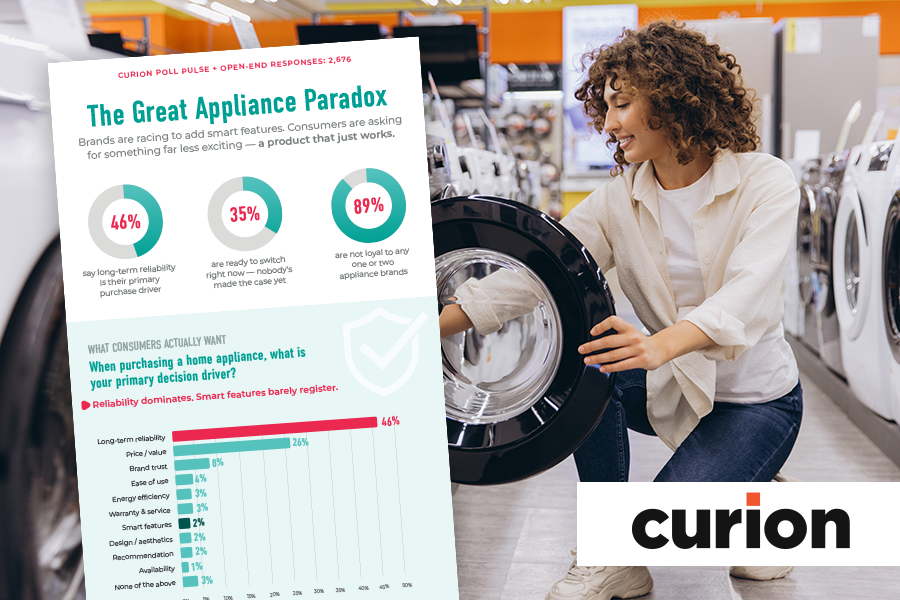
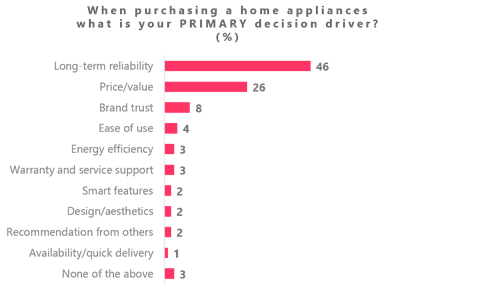
When consumers are shopping, long-term reliability drives nearly half (46%) of all purchase decisions, beating out price/value (26%) and brand trust (8%). Smart features, design, and energy efficiency barely register.
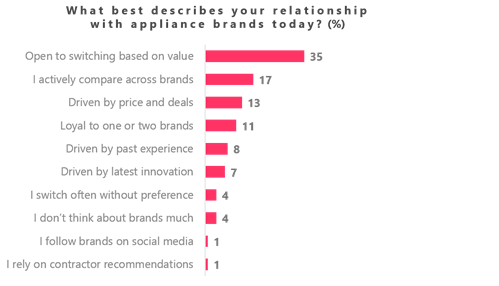
That hesitation shows up in the loyalty numbers too: according to Curion’s research, only 11% of appliance consumers consider themselves loyal to one or two brands.
The gap between what brands are building and what consumers truly care about is wide. And the current playbook for appliance products isn’t working on creating a lasting emotional connection. That’s a window of missed opportunity that most brands are leaving open.
Appliance Brand Loyalty Is More Fragile Than Brands Think
Only 11% of consumers consider themselves loyal to one or two brands. The vast majority are actively open: 35% will switch based on value, 17% actively compare across brands, and 13% are driven by price and deals.
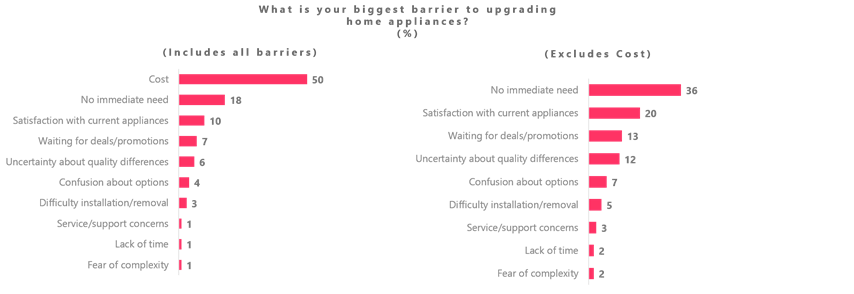
That 35% who describe themselves as “open to switching” aren’t completely lost to capturing brand loyalty, but they need someone to make a compelling case. 12% cite uncertainty about quality differences as a barrier, and another 7% say they’re simply confused by their options.
It’s not the competitors that brands need to worry about. These consumers are being stopped by uncertainty about quality differences or too many options that all look the same, so they stall out and walk away without buying anything.
The Real Frustrations Driving Appliance Brand Loyalty Gaps
Partnering with the Curionblue team and using a new AI tool, we analyzed thousands of open-ended responses to understand what consumers would change about appliance brands and which brands felt most aligned with them.
Across the board, the top frustrations hit on the consumer experiences:
- No real human on the other end when something goes wrong
- Messaging that feels dishonest or overhyped
- Products that don’t deliver on their promises
- Experiences that are just too complicated
Consumers want a real person on the other end when something goes wrong. “Offer real customer service, not AI bots,” said one. “Having humans to talk to when there are problems” said another. They want honesty: “Be honest and not embellish.” And they want simplicity: “Stop trying to make things sound fancy and just focus on the basic functions.”
Consumers are asking for more humanity, honesty, and practicality. Less marketing spin or tech-feature hype. The future of this category will not belong to the brands that add the most features – so says the consumers!
The Buyer Brands Are Ignoring... And Shouldn't Be
For years, the appliance industry has chased the assumption that future growth lies with younger consumers. But while Millennials and Gen Z are buying homes later and living with greater flexibility, many large household purchases remain deferred until life feels more permanent.
Meanwhile, consumers over 50 are driving a different story and getting louder about it. Far from slowing down, many are entering a stage of renewed investment in their homes. Our ethnographic work revealed a deep emotional connection to the products and brands they invite into the next chapter of their lives. One respondent in this study said it directly: “I feel like brands try to cater to the younger generation. But it’s the older ones who lead the pathway.”
It raises an important question: in pursuing tomorrow’s homeowner, are brands overlooking today’s most engaged and intentional buyers?
How Appliance Brand Loyalty Differs Across Generations
Breaking down thousands of open-ended responses, we revealed something very important for product leaders and marketers: while consumers across generations share a desire for trust and reliability, they arrive there through very different paths.
Consumers over 50 are product-first. Their language centers on reliability, value, warranties, and ease of use. One said simply: “I want brands that will hold up under use. I do not want to be constantly buying new items.” Another: “I want average people giving honest opinions. I do not need a cute ad with no substance to it.” For this group, trust is built through performance. Win them with substance, communicate plainly, and deliver exactly what you promise. Marketing channels matter far less than confidence that the product will deliver on its promise. For this group, trust is built through performance. Win them with substance, communicate plainly, and deliver exactly what you promise.
Consumers under 50 are relationship-first. They scrutinize messaging, advertising, and brand behavior before they evaluate the product itself. Authenticity and human interaction matters. They want to feel that a real person is speaking to them. For a generation actively comparing brands and willing to switch, how a brand communicates may matter just as much as what it sells.
Across generations, reliability is the foundation. The path to it just looks different depending on who you’re talking to.
The Real Competitive Gap Is a Communication Problem
In a category increasingly crowded with similar products and technology claims, many consumers struggle to distinguish one brand from another due to communication and messaging, not the product itself.
Brands keep trying to win appliance brand loyalty with better specs. But the real fight is happening in how they talk to people.
The consumers have spoken: the brands that will lead the next chapter of this category won’t be the ones that build the smartest appliances. Instead, the winning brands will be focusing on making consumers feel the most confident bringing them into their home.
Want The Full Picture?
We turned this research into an infographic breaking down the key stats on reliability, loyalty, and what’s really driving appliance purchase decisions.