
 From AI becoming business as usual to the growing importance of data quality and human judgement, IIEX Europe 2026 showed that the conversation has moved beyond technology, and firmly onto better decision-making.
Our team recently attended IIEX Europe 2026 in Amsterdam, where thousands of researchers, brands, agencies and technology providers came together to explore what’s next for the insights industry.
Representing Curion were Hannah Over and Tom Ullathorne, who spent two days attending keynote sessions, joining discussions and speaking with industry leaders about the trends shaping the future of market research.
Their overwhelming impression? The event was busier than ever, AI featured in almost every conversation, and yet the most valuable discussions weren’t about the technology itself, they were about how to use it responsibly, intelligently and to make better business decisions.
Drawing on Hannah and Tom’s reflections, here are the five biggest takeaways from IIEX Europe 2026 and what they mean for researchers, brands and insight teams.
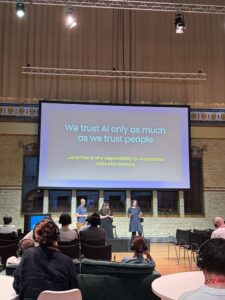 The biggest shift wasn’t the emergence of new AI tools, it was the realization that AI has become standard.
Clients now assume research platforms will include AI-powered capabilities. Simply offering AI is no longer enough to stand out.
Instead, conversations centered around questions like: Can we trust the outputs? How is the data being used? Where is the human oversight? How transparent is the process?
The organizations creating real value are applying AI thoughtfully, with strong governance, clear methodology and confidence in the results.
The takeaway: AI is expected. Trust is what differentiates.
 Rather than replacing researchers, AI is reshaping their role.
Routine analysis, summarization, and repetitive tasks are increasingly automated, allowing researchers to spend more time where they create the greatest value: interpreting findings, challenging assumptions, connecting insights to business decisions, telling compelling stories, and advising clients strategically.
The strongest message throughout the conference was that AI and human expertise work best together.
AI delivers speed, scale and pattern recognition.
Humans provide judgement, empathy, context and accountability.
This was particularly evident in discussions around synthetic personas. While many organizations see huge potential for rapid concept testing and early-stage innovation, there remains healthy debate around data quality, representativeness and appropriate use cases.
Synthetic personas are a valuable addition to the research toolkit at the right time, but not as a total replacement for real human insight.