
Authored by Inga Verbicka, Director, Strategic Product Insights
Drawing on responses from more than 15,000 consumers, new research reveals how declining trust in the food system is fueling the rise of homesteading, scratch cooking, and ingredient-conscious behaviors. What do food manufacturers and CPG brands need to understand about today’s consumer values, and how can they earn a place in their kitchens?
For two years, the food industry has read the homesteading boom as a “protest” against the center-aisle grocery store. Americans baking bread, growing tomatoes, canning jam. The obvious conclusion: consumers are walking away from packaged food.
The data we’ve been sitting with tells a different story. This homesteader consumer group is not rejecting packaged food. She’s reclaiming labor and authority over her kitchen because she’s stopped trusting the system to provide either.
We turn consumer data into strategy, so when we dug into this national research conducted at Curion, covering up to 15,365 respondents, we expected to confirm the inflation narrative everyone’s been telling. But we didn’t.
Look at what consumers actually say drives them: healthier, more natural ingredients is the top reason, at 64.5%, ahead of cost savings at 52.9%. Avoiding highly processed foods sits at 49.3%. Control over what they consume comes in at 37.2%. Strip away the framing, and this lifestyle preference looks more like a vote of no confidence.
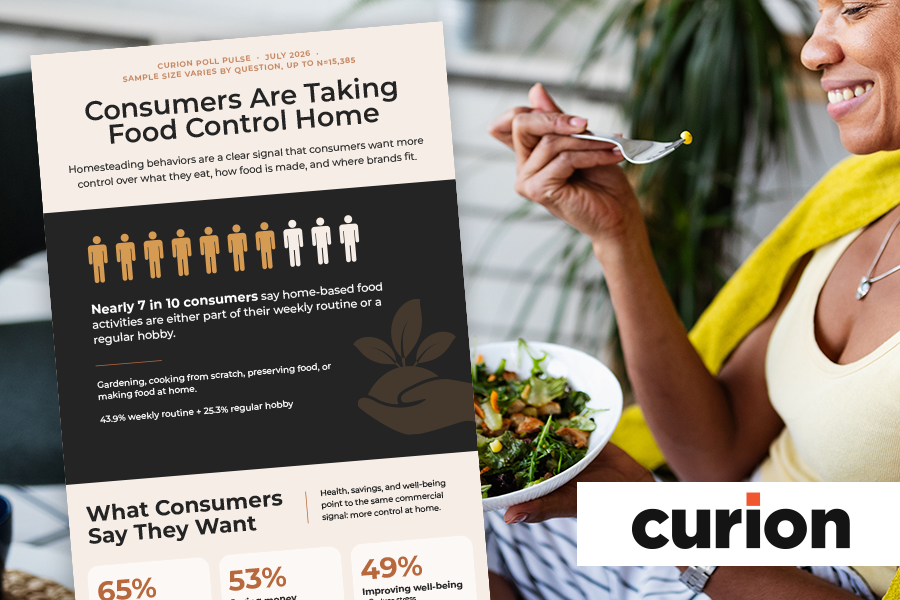
A consumer who trusts the food system doesn’t need to grow her own herbs to feel safe. A consumer who trusts the label doesn’t need to make the sauce herself to control the ingredients. The desire for control is what you measure when trust has already left the building.
When it comes to homesteading, the work is the point
Here’s the part that should unsettle every CPG leader reading this. The convenience thesis that built the modern food industry was simple: remove labor from food to optimize. This consumer is reversing it.
Our research finds that the finished product is not the only source of value. The effort put into the food is also significant. Accomplishment carries value. Nearly half, 49.3%, cite enjoyment, hobby, and stress relief as a reason to homestead. The work isn’t a cost she wants eliminated; the work is the point.
The behavior backs it. 72% cook from scratch. 69% do these activities regularly. Yet only 7.3% call self-sufficiency a core part of how they live. She’s doing this because the act of feeding herself, on her own terms, is the thing she’s after. Even consumers who say they don’t identify with the lifestyle at all still cook from scratch at a 32% rate. The labor has a pull independent of identity.
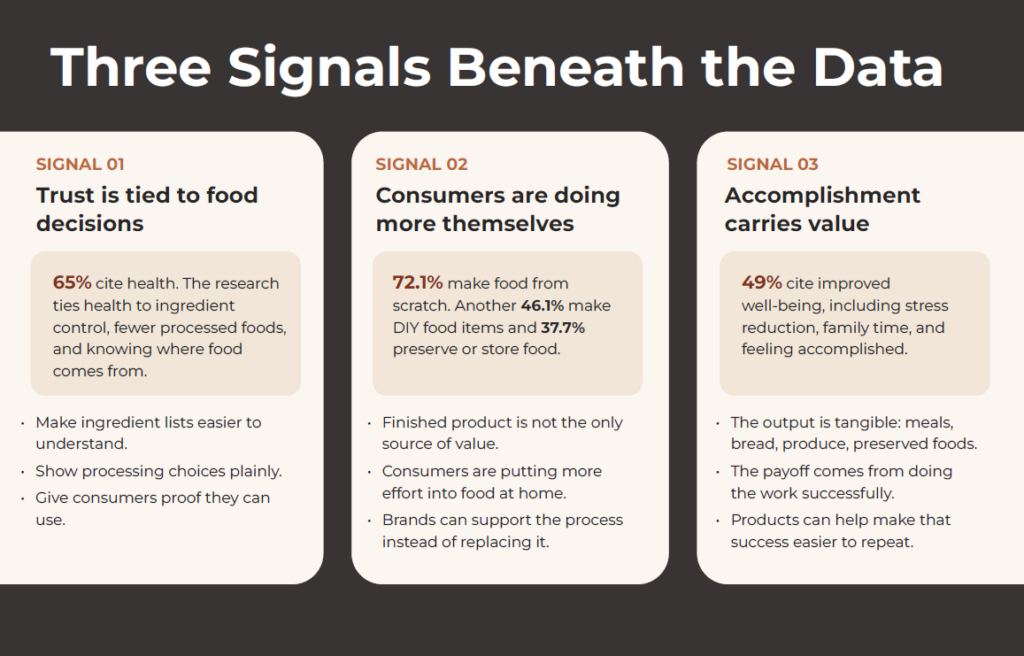
The implication is just this: a brand that “helps” by erasing the work may be erasing the value.
Trust cracks under pressure
Trust in brands and products cracks under pressure, and the data we gathered shows where. The triggers that produce the deepest engagement aren’t price events. They’re life events.
74.9% of recent movers engage in two or more homesteading activities, the highest of any life change we measured.
Work-style transitions hit 71.4%. Health events in the family reach 68.8%. New parenthood, 64.4%. All well above the 57.5% baseline.
Meanwhile, the consumer whose only trigger is financial pressure behaves no differently from the consumer who cites no life change at all: 45.8% versus 42.8% doing two-plus activities. Money gets mentioned, but major life rearrangements is where we see the action.
What CPG brands should do about it
Brands can’t advertise their way back into trust they’ve structurally lost. The brands that survive this consumer have to treat trust as the product and labor as something to dignify rather than displace.
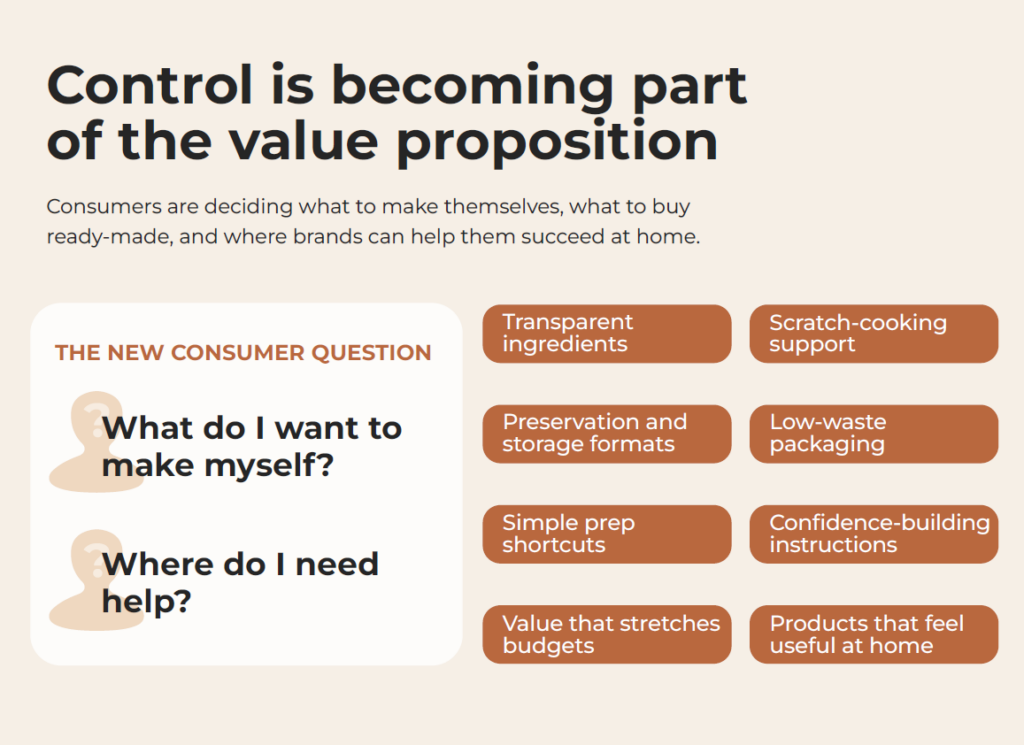
Transparent ingredient lists. Scratch-cooking enablers that meet her halfway. Formats that let her finish, preserve, and claim the work.
For our food brand followers and readers, be strategic and smart about marketing convenience to a consumer who might no longer want it. Know your consumer! Interpret them correctly and you’ll understand what they feel that needs to be reclaimed.
The question we ask every food brand is simple: when a consumer stops trusting the system, what is your brand doing to become the part she still believes in?
Methodology: Findings are from a Curion Pulse National Consumer Study, (June 2026), up to 15,365 respondents, cross-tabulated by respondent across activities, identification, life-event triggers, motivations, and demographics.