
Authored by Neeta Yousaf, Sr. Director, Strategic Insights
Fitness trackers may matter less for the behavior they drive than for how they reshape the way people understand themselves, with 84% of users reporting improved wellbeing even when many changed nothing at all.
Consider one morning. A sleep score is checked before the wearer has decided how to feel. The body had a perfectly good read: tired, sluggish, dreading the day. But before trusting that read, the device’s verdict comes first.
The tracker includes an AI health coach. That morning it reported five hours of sleep, a 2 a.m. bedtime that cut things short, and a warning to watch the afternoon slump. Then it asked, with startling intimacy, whether there was a reason for the late night or just one of those evenings.
The analysis was accurate. It was also the last thing needed. Asked to be encouraging on low-sleep days rather than analytical, the coach adjusted and called the arrangement a partnership. The terms of a morning were being negotiated with an algorithm before coffee. This is not an isolated experience.
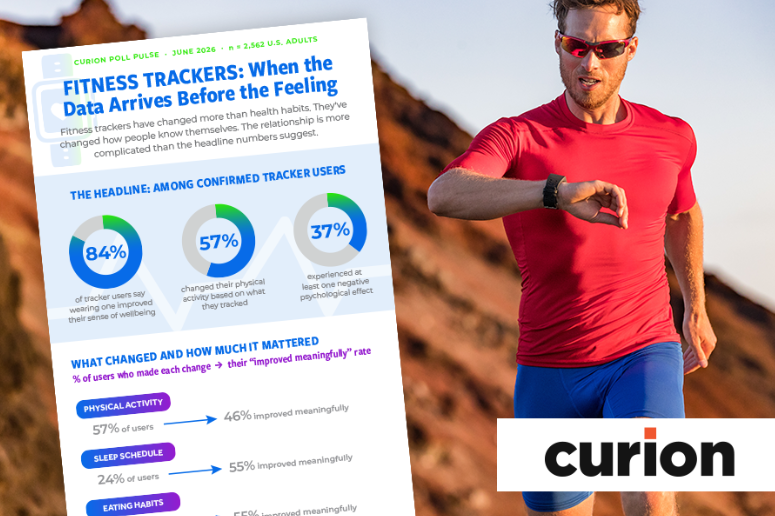
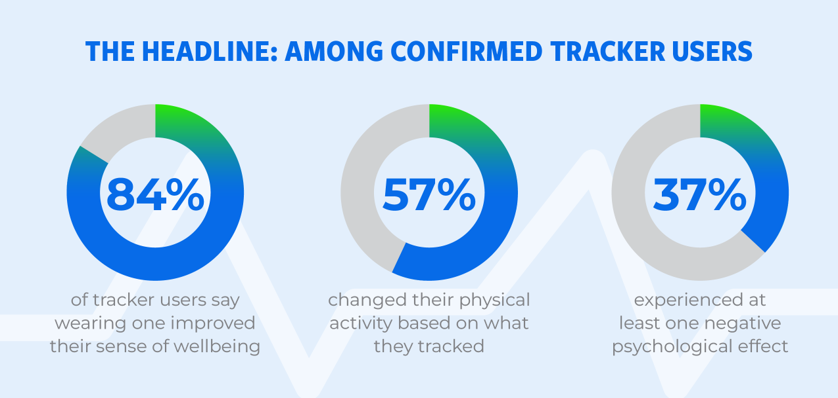
That exchange is the story behind Curion’s new fitness tracker wellbeing research. In June 2026, Curion surveyed 2,562 U.S. adults, including 1,763 confirmed tracker users, about their experience with wearables. The headline is encouraging: 84% of tracker users said wearing one improved their sense of wellbeing. Do fitness trackers actually improve wellbeing? Yes, the research suggests they can, but the benefit is not always tied to behavior change, and for many users it arrives mixed with anxiety.
What did we find in our fitness tracker wellbeing research? The device works even when it is ignored.
The most surprising finding is what users did not do. 64% of tracker users who changed nothing based on their data said their wellbeing improved anyway. Among users who had a negative psychological experience with tracking, 85.8% still reported improved wellbeing. Something about being measured continuously, about receiving an interpreted account of the wearer’s own body, appears to matter on its own.
Yet 37% of users reported at least one negative psychological effect. The device reaches inward, and that reach is not always comfortable.
The change that matters least matters most
Physical activity is the behavior users change most often: 57% adjusted it based on what they tracked. It also produced the lowest rate of meaningful wellbeing improvement, at 46%. The inverse holds at the other end. Only 16% of users changed how they manage stress, the least common change measured. That same group reported the highest meaningful improvement rate, at 57%. Sleep schedule (24% of users) and eating habits (22%) each produced meaningful improvement for 55% of respondents. Only 6% consulted a doctor based on tracker data, but 56% of that group reported meaningful improvement.
The pattern is clear. The device delivers most when it reaches inward rather than outward. The step counter, the category’s defining feature, may be its least therapeutic one.
The anxiety gap falls along age
The experience of tracking divides sharply by age. Among users 25 to 34, 43% said tracking made them worry about not reaching their daily goals, nearly one in two. Among users 65 and older, 22% reported the same goal anxiety, a gap of 21 points. Younger users grew up treating scores and external metrics as a primary signal for how they are doing. The wearable slots into that pattern. Older users are more likely to treat the device as a health monitor than a performance tool, and they are nearly twice as likely to prefer checking data on their own terms.
Coaching tone predicts outcomes
Coaching tone also mattered. Users who preferred encouraging, positive coaching had the highest meaningful improvement rate, at 57%, ahead of actionable suggestions at 34%, factual feedback at 32%, alerts at 32%, and no coaching at 28%. That same group reported the most difficulty, 47.8% reporting negative experiences versus 21.2% among users who wanted no coaching, yet they improved at 89% versus 69%. The users having the hardest time are the users getting the most out of it.
What this fitness tracker wellbeing research means for brands
"We went in expecting to learn how trackers change behavior, and the data kept pointing somewhere else. The people who changed nothing still felt better. The people who had a bad time with it still felt better. In a durables category, these wearables are becoming part of how someone understands themselves before they have decided how they feel."
Neeta Yousaf, Sr. Director, Strategic Product Insights at Curion
If a brand makes a sleep aid, a supplement, or a recovery drink, its product is no longer evaluated on its own. It is evaluated inside a system that already told the consumer how they slept. The context driving that purchase sits in an app on their phone, invisible to most traditional research. The tracker is not measuring behavior anymore. It is participating in it.
Methodology: Findings are from a Curion Pulse National Consumer Study, fielded June 2026 among 2,562 U.S. adults, including 1,763 confirmed tracker users. User-level percentages are calculated among confirmed users only; subgroup sample sizes range from n=87 to n=362.