
Authored by Emily Simmers and Jackie Lipkowitz, Directors, Strategic Insights
Brands can win the cart with a protein claim and still lose the lunchbox. 54% of parents with kids ages 5 to 13 prioritize portability when choosing school snacks, while calorie count ranks dead last.
This past August, I stood in the grocery store with one hand on a cart and the other holding a crumpled school-supply list. My kids were due back in class in a few days, and the familiar back-to-school calculation had begun: charged computers, earlier bedtimes, a workable morning routine—and lunches they would actually eat. I paused in the snack aisle, comparing labels while mentally picturing what could survive a backpack, fit into a lunchbox, and still look appealing by noon.
It is a small scene repeated by parents everywhere. Back-to-school shopping means solving a daily puzzle: what fits the routine, the backpack, and the kid. Parents want products that make mornings easier, give them confidence in what they are packing, and pass the most important test of all: their child wants to eat them.
What Parents Are Really Shopping For
Curion’s August 2026 PULSE poll of parents with children ages 5–13 shows how practical those choices are. Portability and on-the-go convenience ranked highest at 54%, closely followed by lunchbox-friendly formats at 53%. Kid-approved taste mattered to 47% of respondents, while 43% prioritized individually wrapped products. No refrigeration needed reached 38%, and mess-free options were selected by 29%.
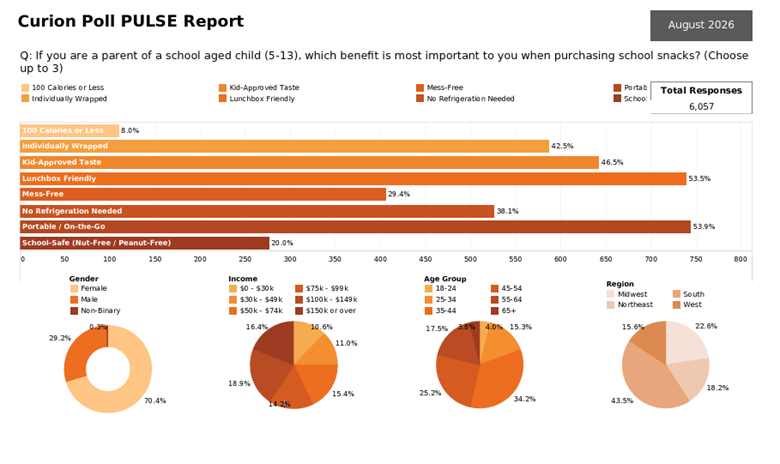
Together, these findings paint a clear picture: parents are looking for products that work in real life. They are filling lunchboxes with portable snacks, bars, crackers, fruit or vegetable options, cheese, yogurt, protein-forward bites, and easy-to-open packs that can travel safely through the school day. Nutrition still matters—especially simple ingredients, less sugar, and protein—but it must arrive in a familiar format with a taste and texture children accept.
That creates a demanding brief for brands. A compelling claim may win attention at the shelf, but it cannot guarantee the product will be opened, enjoyed, finished, or requested again. A snack can look perfect to a parent and still come home untouched because the flavor was unfamiliar, the texture changed in a warm backpack, the package was too hard to open, or the portion did not feel right.
The Lunchbox Has Two Consumers
Successful lunchbox products must satisfy two consumers at once: the parent who buys and packs the product, and the child who decides whether it gets eaten. Each consumer group can help brands move beyond asking whether an idea sounds appealing, to understanding how the full experience performs—from flavor, aroma, texture, and appearance to packaging, claims, portion size, and ease of use.
Testing with the right parent-and-child audiences can reveal the questions that matter before launch:
- Does the protein claim increase purchase interest?
- Is the “better-for-you” message believable?
- Which flavor brings children back for another bite?
- Can they open the package independently?
- Does the product hold up outside the refrigerator?
- What drives kids to ask for it again, and what quietly sends a snack back home?
By combining consumer understanding with sensory and product-performance learning, brands can prioritize the claims that actually motivate parents, optimize taste and texture for kid acceptance, and evaluate packaging and portability against real school-day routines. That’s how the strongest product surfaces before launch, and how the final story lines up promise, experience, and repeat purchase.
Test Before the First Bell
I ended up buying the same crackers I buy every year, simply because I know my kids will eat them. That’s the real test, and it’s one no shelf claim can pass on its own.
Every August, parents run this same experiment across millions of kitchen tables: does the snack survive the backpack, the eleven a.m. hunger, the trade with a friend at the lunch table.
The data confirms what most parents already sense standing in that aisle. When it comes to what we pack in our kids’ lunchboxes, convenience and kid-approval decide far more than a protein number on the front of the box.
For brands, that’s the harder brief. A great claim gets a snack into the cart once. Fit, taste, and portability decide whether it comes back next week.